

Backlinks · authority engineering
Most agencies buy links. We engineer ranking probability.
Every backlink scored by cosine similarity. Verified for page-level traffic. Classified at 99%+ accuracy.
DR is two dimensions. Google works in three. Here is the part most agencies still get wrong: they judge a link by Domain Rating, a score invented by a marketing tool, not by Google. That model stopped working in 2021. Google ranks on relevance, real traffic and topical coherence. Domain Rating tells you none of that.
Two links from the same site. Same spot on the page, same price. One passes 3× more authority than the other. The difference: one sits on a page that is actually about your topic. Most agencies never check. We score it for every link.
- Page-level traffic
- Verified
- Ranking for a related keyword
- Yes
- Domain Rating
- 70
Linking page is specifically about the same topic
3× authority passed
- Page-level traffic
- Zero
- Ranking for a related keyword
- No
- Domain Rating
- 70
Broadly related
Baseline
Both links cost the same. Only one of them is measured.
01. The diagnosis
DR70. Zero page traffic. That's why nothing moved.
Your agency reports the metric it can control. Not the one Google uses to rank you. You are paying for Domain Rating. Google does not use it. A DR70 link from a page with zero traffic will not move your rankings, and neither will a placement bought purely for the brand mention.
Two signals determine ranking probability
Does the page actually get visited?
This matters at page level, not site level. A forgotten page on an otherwise popular site sends you nothing, because nobody clicks a link nobody sees.
Is the page already ranking for a keyword related to yours?
If a page already ranks for a topic close to yours, Google has already decided that topic belongs there. Everything else is a guess dressed up as a plan.
That's it. Everything else is noise.
Your site has a big ego.
An enterprise-grade Domain Rating does not mean your product pages are ranking. Large brands watch their commercial pages get outranked by smaller competitors every day. Puffed on the outside. Weak on the inside. The real issue isn't how much authority your site has overall. It's whether that authority ever reaches the pages where you actually make money.
The relevancy layer is missing. WLDM links build it.
Every link WLDM builds goes to a specific commercial page, from a page already ranking for a related keyword. Not brand mentions. Not editorial features with no topical connection. Just direct, relevant links aimed at the pages that actually bring in business.
02. The evidence
Google's own code named the signals.
In 2024, Google's internal Content Warehouse API was accidentally exposed. The production fields named the exact signals WLDM had already been scoring since 2021. The leak closed the argument.
What the 2024 leak exposed
siteFocusScore
How topically concentrated a domain is. A site that covers one clear subject is treated as more trustworthy in it than a site that jumps between dozens. Links from a focused site carry more weight, regardless of DR.
siteRadius
How far individual pages drift from the site's topic centroid. One SEO article on a cooking blog has high siteRadius: a weak topical signal, however established the blog looks.
sourceType
Google's own quality tier for the linking page: HIGH, MEDIUM or LOW. A HIGH-tier source passes noticeably more authority. Domain Rating does not capture it, and most agencies never look.
Google runs vector math on authority. Not link counting. Not domain rating.
Documented by Mike King, iPullRank, and SparkToro. Read the 2024 Content Warehouse API analysis.
The Reasonable Surfer patent
Google's Reasonable Surfer patent (US 7,716,225, filed 2004, granted 2010) assigns link weight by the probability a link is clicked. The idea is simple: a link only has value if a real person would click it. A link buried in a footer nobody notices is worth almost nothing. A link sitting inside a paragraph someone is actually reading is worth far more. Domain Rating treats both the same way, which is the whole problem.
- Page-level traffic matters more than domain authority.
- Links from ranking pages outperform links from dormant ones.
- Domain Rating was invented by SEO tools. It is not in Google's algorithm.
The patent formula:
r(A) = α/N + (1-α) · ( w1·r(B1)/|B1| + … + wn·r(Bn)/|Bn| )
where w is the click-probability weighting for each linking page.
In the 2024 Content Warehouse leak, the Reasonable Surfer maps most closely to GoogleApi.ContentWarehouse.V1.Model.AnchorsAnchor. Key fields:
- pagerankWeight"Weight to be stored in linkmaps for pageranker."
- sourceTypeQuality and importance of the source page (HIGH, MEDIUM, LOW). This is the leak's closest proxy for page-level traffic. A HIGH-tier page is one that Google treats as important and crawls regularly, which correlates directly with real traffic. A zero-traffic page will not reach HIGH regardless of its domain's DR.
- weightGoogle's internal authority score for the anchor, on a 0 to 127 scale. Higher values indicate more PageRank-style authority transferred through the link.
- fontsize, context, context2, fullLeftContext, fullRightContext, offset, linkTags, locality, bucketFeatures around the link and anchor, corresponding to the patent's weighting by document and positional features.
The leak confirmed that Google stores and uses multiple PageRank variants per document: PerDocData.pagerank0, pagerank1, pagerank2, crawlPagerank, toolbarPagerank, and homepagePagerankNs.
Topic variants (pagerank0, 1, 2) for bucketed authority weighting. A crawl priority score (crawlPagerank) that determines how often Google revisits a page, which correlates with real traffic. A site-level homepage score (homepagePagerankNs). And the old public toolbar score, still tracked internally long after Google stopped publishing it.
The takeaway: this was never one number. It is a multi-dimensional authority model, and none of it maps to Domain Rating.
03. Relevance, scored
Relevance is a number.
We calculate it before we build.
Cosine similarity scores every candidate link from 0 to 1 for how closely a linking page's topic matches your target page. Think of it as an authority multiplier. From the same domain, a link scoring CS 0.6 passes roughly three times the authority of one scoring CS 0.2. Same placement, same cost. Triple the transfer.
CS scoreWhat it means
We score every candidate link before we build it. Anything below CS 0.2 never gets built, and CS 0.4 is the working floor. Most agencies skip this step. They check the domain's DR, decide that is good enough, and move on.
Each text x becomes a 384-d embedding v(x), mean-pooled and L2-normalised, so ∥v∥=1. Cosine is then the dot product:
cos(a,b) = (a·b) / (∥a∥∥b∥) = a·b
Let c = cos(context, target), r = cos(refPage, target), a = cos(anchor, target).
base = 0.65·c + 0.35·r
δ = -0.15 if a < 0.15 (anchor mismatch demotion)
δ = min(0.10, 0.20·a) if c ≥ 0.40 (relevant anchor in strong context)
δ = -0.10 if a > 0.45 and c < 0.30 (exact match in weak context, over-optimised)
δ = 0 otherwise
score = clamp(base + δ, -1, +1)
Why context gates the anchor: a keyword-rich anchor like "buy gold online" always scores high against a "buy gold" page. That overlap is circular, not evidence of a good link. The discriminator is whether the surrounding paragraph supports it. Strong context means a natural descriptive link, and earns a small bonus. Weak context means the same match reads as over-optimisation, and takes a penalty.
Notice the penalty (0.15) is larger than the bonus (0.10). That is intentional: Google's link system is cautious by design. A bad anchor hurts more than a good one helps.
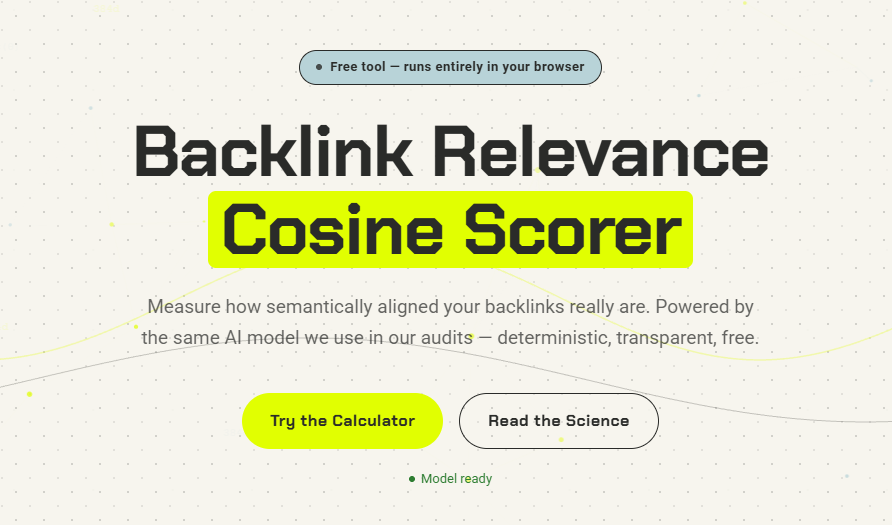
Cosine Scorer
Don't take our word for it. Run the same model we use internally on any link you are considering. Cosine Scorer, free, no login cs.wldm.io
04. The measure that matters
PageRank measures popularity.
Harmonic Centrality measures efficiency.
Stop optimising for fame. Optimise for network position. Frankfurt Airport moves more passengers through its gates every year than Paris Charles de Gaulle, and Paris is by far the more recognisable name. A famous name does not mean better connections. Domain Rating is Paris. Harmonic Centrality is Frankfurt. A well-connected node passes authority faster and more completely than a high-DR domain with poor connectivity.
Paris Charles de Gaulle
High DRHigh DR, poor connectivity. Famous, and slow.
Frankfurt Airport
High HCLess famous, better connected. Authority moves through it faster and more completely, which is what actually reaches your target page.
Harmonic Centrality measures where a page sits in the authority network, not how well known its domain is. WLDM scores each target page by CS-weighted in-degree Harmonic Centrality: every incoming link weighted by its relevance, then added up. A direct link counts most. Each extra hop roughly halves the contribution. Links with no topical relevance are not simply scored down. They are excluded from the graph entirely.
The multi-target publisher advantage
Here is what most agencies miss. A domain that places relevant links across several of your target pages accumulates Harmonic Centrality multiplicatively, not additively. One publisher with six topically matched placements generates more total HC than twenty single-link domains at similar DR. This is what WLDM's database is built to find. On the Stake.com engagement, one entertainment publisher delivered 2.44 total HC from 6 placements at an average CS of 0.56. No single high-DR domain with one link came close.
2.44
Total harmonic centrality, one publisher
HC(u) = Σ 1/d(v,u)
Where d(v,u) is the shortest path from linking page v to target page u, weighted by cosine similarity. A highly relevant link one hop away contributes far more than a dozen loosely related links two hops out.
WLDM scores every placement by Harmonic Centrality contribution before acquisition. Google's 2024 API leak confirmed the same idea in production: topical concentration, topic drift and crawl priority, all stored per document.
05. The pipeline
We don't guess at the methodology.
We build it.
Two metrics decide everything that matters: whether a page has real traffic, and whether it already ranks for your keyword or a close relative. Measuring both at scale takes a system most agencies do not have.
-
01
Classify
ML quality classification
- 18,000+ domains in training data
- BERT entity extraction
- 5 independent classifiers
- 3 of 5 must agree before a link is built
-
02
Score
Cosine similarity, not DR
- Every opportunity scored against target keywords
- Page-level topical relevance
- Not domain authority
- CS 0.4+ only
-
03
Verify
Traffic, not vanity metrics
- Every linking URL verified for real page-level traffic
- No traffic means no value
- We don't build it
-
04
Build
Harmonic Centrality scored
- Authority graph construction
- Placement targets ranked by HC contribution
- Confirmed by Google's 2024 API leak
Database extraction
We started building the link database over four years ago and have run a data science team for just as long. Hundreds of thousands of dollars went into the database, and years went into refining the extraction method. It currently covers over 600,000 domains at 1,000 passes each, all vectorised for our link extraction method.
Quality assurance
We run the client's topic through WLDM's proprietary link database, the largest of its kind we know of, and through our machine-learning classifiers, which score and qualify backlink targets at 99%+ accuracy. Instead of filtering by raw Domain Rating, the system maps the client's entity and topic graph and surfaces the domains and pages that are contextually closest, ranked by semantic proximity and harmonic centrality. It sifts thousands of candidate sources in minutes and hands outreach a pre-qualified target list. Doing the same work by hand would take more than 100,000 hours per keyword.
Manual outreach
Qualified targets go to a human team. Every pitch is written for the specific editor and the specific page. Real relationships, real editorial placements, on sites that are already ranking for the keyword you want to rank for.
Most link building is a list someone bought off a shelf. Ours starts inside our own data and ends with a real person reading an email written for them specifically. We do not sell open-ended engagements. We scope a 3-month project to a defined outcome and hit it.
06. Head to head
Below rank 30 to #1 for "Online Casino."
10 months. No shortcuts.
Monthly searches
Keyword difficulty
Monthly traffic value
Same client account. Same pages. Same target keywords, measured directly against the previous provider's link programme.
| Metric | WLDM | Previous provider |
|---|---|---|
| Links analysed | 603 | 30 |
| Average target-page HC | 1.59 | 0.37 |
| Difference | +330% (4.3×) | baseline |
| Zero or negative CS links | 18.6% | 30.0% |
The previous provider ran a brand and PR programme: F1 sponsorship coverage, cricket news, lifestyle press. It looked impressive on paper, but 63% of those links sat in the zero, negative or low relevance tiers. Plenty of people saw the brand name. Almost none of it turned into ranking power for the commercial pages that needed it.
4.3× more harmonic centrality delivered to target pages.
78% higher average topical relevance per link.
6 major commercial pages with zero competitor HC coverage.
Non-brand organic traffic doubled in 90 days.
Where the 4.3× comes from
The same link graph, with every node weighted by its harmonic centrality contribution rather than its domain rating. The links that matter cluster together, tight to the target page and tight to the topic. The previous programme was buying the outer scatter: links that looked fine one by one but connected to nothing. WLDM targets the centre first, which is why the same budget delivered 4.3× more centrality to the pages that mattered.
"Within 90 days of engagement, WLDM's strategic link acquisition efforts helped us secure #1 positions for several ultra-competitive keywords and doubled our non-brand organic traffic."
 Peter MacinkovicSEO Lead, Stake.com
07. The methodology gap
The methodology gap, on paper.
| Feature | Everyone else | WLDM |
|---|---|---|
| What you're buying | Links | Ranking probability |
| How quality is measured | Domain Rating (DR) | Cosine similarity + Harmonic Centrality |
| Signals used | Anchor text, referring domain count | siteFocusScore. siteEmbedding. pageEmbedding. |
| Technology | Manual outreach | ML classifiers at 99%+ accuracy across 5 models |
| Training data | None published | 18,000+ domains |
| Optimises for | Google and AI retrieval systems | |
| What you receive | A link report | A mapped authority graph and citation cluster analysis |
| Results measured by | Links built, DR gained | Ranking probability and citation probability |
08. The audit
We will score your existing backlinks against the signals Google actually uses.
Most agencies have never done this to their own work. You will see why.
We audit your current backlinks, score each one for page-level traffic and topical match, identify which are contributing to rankings and which are not, and map the gaps your competitors are already filling. You leave with a clear picture of what your investment has actually returned and a 90-day plan for what comes next. We start with your data, not a pitch deck.
What the audit delivers
1
ML quality classification
Every domain linking to you runs through the classifier: 5-model ensemble, 99%+ accuracy, trained on 18,000 domains we curated by hand. Each one comes back with a quality tier, or a link-farm flag for the ones quietly working against you.
2
Cosine similarity scoring
Every linking URL scored against your target pages on the three-signal model (65% paragraph context, 35% page body, anchor adjustment). Each link comes back rated Strong, Moderate, Weak or Irrelevant, so you can see at a glance which ones are pulling their weight. Links below the build floor are flagged for disavowal or deprioritisation.
3
Page-level traffic verification
Proof that each link sits on a page real people visit. A link nobody sees carries no Reasonable Surfer weight and contributes almost nothing, whatever the domain's DR. We verify it directly instead of assuming a big name means real traffic.
4
Competitor Harmonic Centrality gap analysis
The HC profile for your top three competitors' commercial pages, mapped against yours. Which publishers carry the most HC weight in your category, which of them link to competitors but not to you, and which of your pages sit furthest behind.
5
90-day authority roadmap
A priority-ordered build plan drawn from everything above: publishers ranked by expected HC contribution × topical match × page traffic, your most valuable pages first, and a realistic timeline for when results should start showing, based on engagement data from our case studies.

A one-hour call with Brie, included
Every audit includes an hour with Brie Moreau himself. Not a sales rep reading a script. Brie built the methodology and runs the science team. He will walk you through what the audit found, what it means for your rankings, and what the right next move looks like. Most agencies charge good money for that conversation. Here it is part of the audit.
Free. No obligation. Reviewed within 48 hours.
If we can't show you something your current agency missed, we'll say so.
Authority compounds.
So does the gap.
Your competitors are not waiting for a better agency report. Every month without the right links is a month that gap widens.